Table of contents
Want to Stand Out to Healthcare Employers? Build These 5 Soft Skills
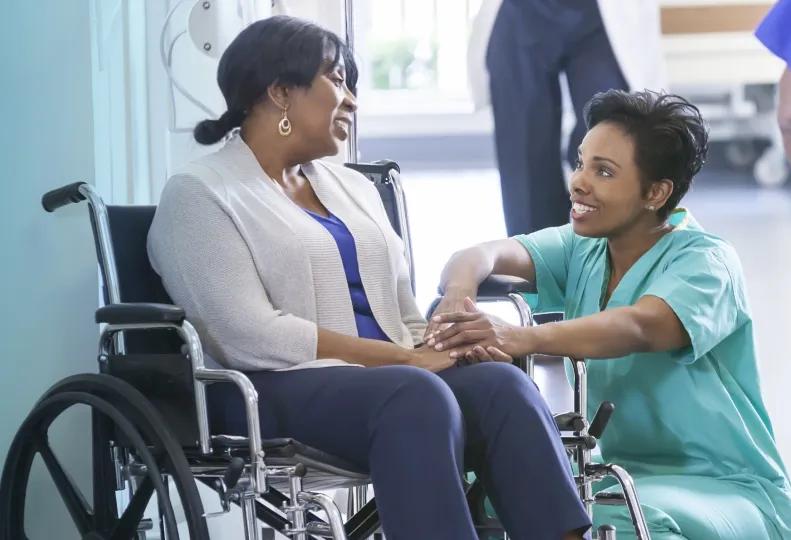
Table of Contents
Key Insights:
- Soft skills are the non-technical skills that can help healthcare professionals perform their jobs more effectively and efficiently. They’re often referred to as personal traits or qualities and involve skills used when interacting with others.
- Healthcare employers may value certain soft skills due to the positive impacts these skills can have on their business, such as improving patient safety and care, as well as promoting worker resilience.
- Compassion, adaptability, and teamwork are just some of the soft skills that are important when working in healthcare. UMA’s healthcare programs are designed with these types of skills in mind, providing learners with both the technical and soft skills needed for their healthcare roles.
People enroll in healthcare programs expecting to gain the necessary technical skills needed to perform their job duties. A medical assistant needs to know how to take vital signs, for instance, while a phlebotomy technician must understand the proper way to draw blood. However, while technical skills are undoubtedly important in healthcare careers, several soft skills can prove important too — and they can greatly influence healthcare employers’ hiring decisions.1
What Are Soft Skills?
Soft skills are non-technical skills that can help you do your job more effectively or efficiently. Often referred to as personal skills, qualities, or traits, these are the skills you use when interacting with others in the workplace, such as when dealing with coworkers or patients. They’re also the attributes that can help you stay calm and focused in the middle of chaos, which isn’t always a simple feat when working in a busy healthcare environment.
Why Do Healthcare Employers Care About Soft Skills?
The National Healthcareer Association indicates that hiring healthcare professionals with certain soft skills can offer organizations several benefits, some of which include:2
- Supporting patient safety
- Increasing patient satisfaction
- Improving patient outcomes
Providing quality care can inspire patients to stay loyal to their healthcare providers. They may even refer family and friends, which can help organizations grow.
One study of more than 1,000 occupations also found that workers with foundational skills, such as the ability to work well in teams, were quicker to pick up specialized skills, more likely to advance, and more resilient when facing industry changes.3 These are not only advantageous for employers, but they can also be beneficial for workers who are interested in advancing their skill sets or want to move into a higher-level position.
5 Soft Skills Important for Healthcare Professionals
Which soft skills might your future healthcare employer be looking for? Here are five to consider.
#1: Compassion
Merriam-Webster defines compassion as the “sympathetic consciousness of others’ distress together with a desire to alleviate it.”4 So, it’s recognizing someone’s pain or discomfort and wanting to relieve it. Compassionate care can improve patient engagement, outcomes, and experiences, while also improving organizational culture and supporting healthcare excellence — even acting as an “antidote” to healthcare worker burnout.5
Compassion in healthcare may be as simple as actively listening when a patient or coworker is speaking. Active listening involves paying attention to what they’re saying instead of thinking about what you’ll say next. It can also involve providing feedback or paraphrasing what they’ve said once they’ve finished talking to show that you’ve heard them.
#2: Communication
Communication is another soft skill that is important in healthcare careers. Being able to effectively communicate with coworkers and patients can help reduce the risk that the information shared will be misinterpreted or misunderstood. Using clear, simple language contributes to effective communication, along with showing others respect.
Nonverbal communication skills matter too. Think about what your body language may be conveying to people you’re speaking with. Does it signal that you’re interested in the conversation and care about the other person? If not, how might you change your posture, positioning, or hand movements to convey your desired message?
#3: Adaptability
Healthcare environments are constantly changing. Technology is being updated, regulations are being modified, and each patient can come with unique challenges and health concerns. Being adaptable enables healthcare professionals to adjust to changes as they occur, making this an appealing quality to healthcare organizations that are faced with making continual adjustments.
Here’s another reason to build your adaptability skills: it helps support lasting resilience.6 Resilience refers to the ability to “bounce back” or recover from adversity. There are mental health benefits too, as psychological flexibility has been associated with lower levels of anxiety and depression.6
#4: Teamwork
In healthcare, doctors, nurses, and support staff all work together to provide patient care. Even behind-the-scenes healthcare roles like medical biller and coder, or medical administrative assistant, are part of a patient’s healthcare team. Being able to work effectively in a team environment contributes to a more cohesive and collaborative healthcare system.
Healthcare employers may also look for job candidates with teamwork skills because higher quality teamwork is associated with improvements in patient safety, satisfaction, and clinical outcomes, in addition to potentially supporting cost improvements.7
#5: Critical thinking
Critical thinking is such an important healthcare skill that many UMA healthcare programs include a course on this topic. Thinking critically involves having the ability to analyze information without assumptions or biases to reach a logical and reasonable conclusion.
One way to build this skill is to think like an investigator. Reflect on the situation at hand, ask relevant questions, and gather the information you need to develop a well-informed solution or conclusion.
UMA Helps Tomorrow’s Healthcare Professionals Build Their Soft Skills
In addition to providing our adult learners with instruction on the technical skills needed for their healthcare roles, UMA also prioritizes soft skill development. In addition to covering some of these skills in certain courses, we also have blogs that talk about:
- Soft skills that are beneficial for medical assistants
- Important soft skills for HHS professionals
- Soft skills learned in medical billing and coding training
- CNA vs. medical assistant soft skill sets
Contact us to learn more about how we can help you develop your soft skills when pursuing a career in healthcare. Our programs are designed with these skills in mind, reinforcing our commitment to prepare you for your chosen healthcare field.
Check out our student testimonials to learn what others have to say about getting their healthcare education at UMA.
FAQs
- What soft skills are important for healthcare careers? Compassion, communication, adaptability, teamwork, and critical thinking are all important skills when working in healthcare. Employers may look for these skills in job candidates. If you have them, be sure to include them on your healthcare resume so they can help you stand out.
- How can I develop soft skills for a healthcare job? UMA’s healthcare programs are designed with soft skills in mind. Several even have dedicated courses to help you build your critical thinking and problem-solving skills. Contact us to learn more.
- Are technical skills more important than soft skills in allied health? Both technical skills and soft skills are important when working in the allied health field. Technical skills can help you perform your job duties using the proper techniques and steps, while soft skills can help you interact with coworkers and patients with respect and care.
- Can soft skills help me move up in healthcare? While having soft skills doesn’t guarantee advancement to a higher-level healthcare position, if an employer prioritizes these skills, you could stand out from job applicants who lack them.
1 Innova People. The Role of Soft Skills in Healthcare Hiring Decisions, para. 1. https://www.innovapeople.com/the-role-of-soft-skills-in-healthcare-hiring-decisions/
2 National Healthcareer Association. How Soft Skills Impact Healthcare Practices, sects. 2 & 3. https://info.nhanow.com/learning-leading-blog/how-soft-skills-impact-healthcare-practices
3 Hosseinioun, M., Neffke, F., & Youn, H., et al. Soft Skills Matter Now More Than Ever, According to New Research. AAPL, paras. 2 & 3. https://www.physicianleaders.org/articles/soft-skills-matter-now-more-than-ever-according-to-new-research
4 Merriam-Webster. Compassion. https://www.merriam-webster.com/dictionary/compassion
5 Ahmed, Z., Ellahham, S., & Soomro, M., et al. Exploring the impact of compassion and leadership on patient safety and quality in healthcare systems: A narrative review. BMJ Journals, abstract/conclusion. https://bmjopenquality.bmj.com/content/13/Suppl_2/e002651
6 Gibson, P. The Art of Flexibility, Resilience, and Adaptability. Psychology Today, from flexibility to resilience. https://www.psychologytoday.com/us/blog/escaping-our-mental-traps/202505/the-art-of-flexibility-resilience-and-adaptability
7 McGueir, E.A., Kolko, D.J., & Aarons, G.A., et al. Teamwork and implementation of innovations in healthcare and human service settings: a systematic review. Implementation Science, background, para. 1. https://implementationscience.biomedcentral.com/articles/10.1186/s13012-024-01381-9
Request Information
Talk with us. Start your journey.
Complete this form and we'll call you to explore options at UMA and answer your questions. We'll also email you info on how to get started. We're with you at every step!
Request Information
Talk with us. Start your journey.
Complete this form and we'll call you to explore options at UMA and answer your questions. We'll also email you info on how to get started. We're with you at every step!
About the Author
 Adam Fenster
Adam Fenster is a senior copywriter at Ultimate Medical Academy, with journalism experience from his time as a reporter and editor for multiple online and print publications. Adam has been covering healthcare education since 2019, with an emphasis on topics such as wellness, healthcare employment, and job preparedness. He received his BA in journalism from the University of South Florida.
Related Content

Exploring the Dental Assistant Career: What’s It Like to Be a Dental Assistant?
Read More